| Read on LessWrong |
Basically every meeting is scheduled with an explicit duration. This is convenient for scheduling, but it implies that the entire meeting is equally likely to give you value. I think there’s a better way to schedule meetings that avoids this.
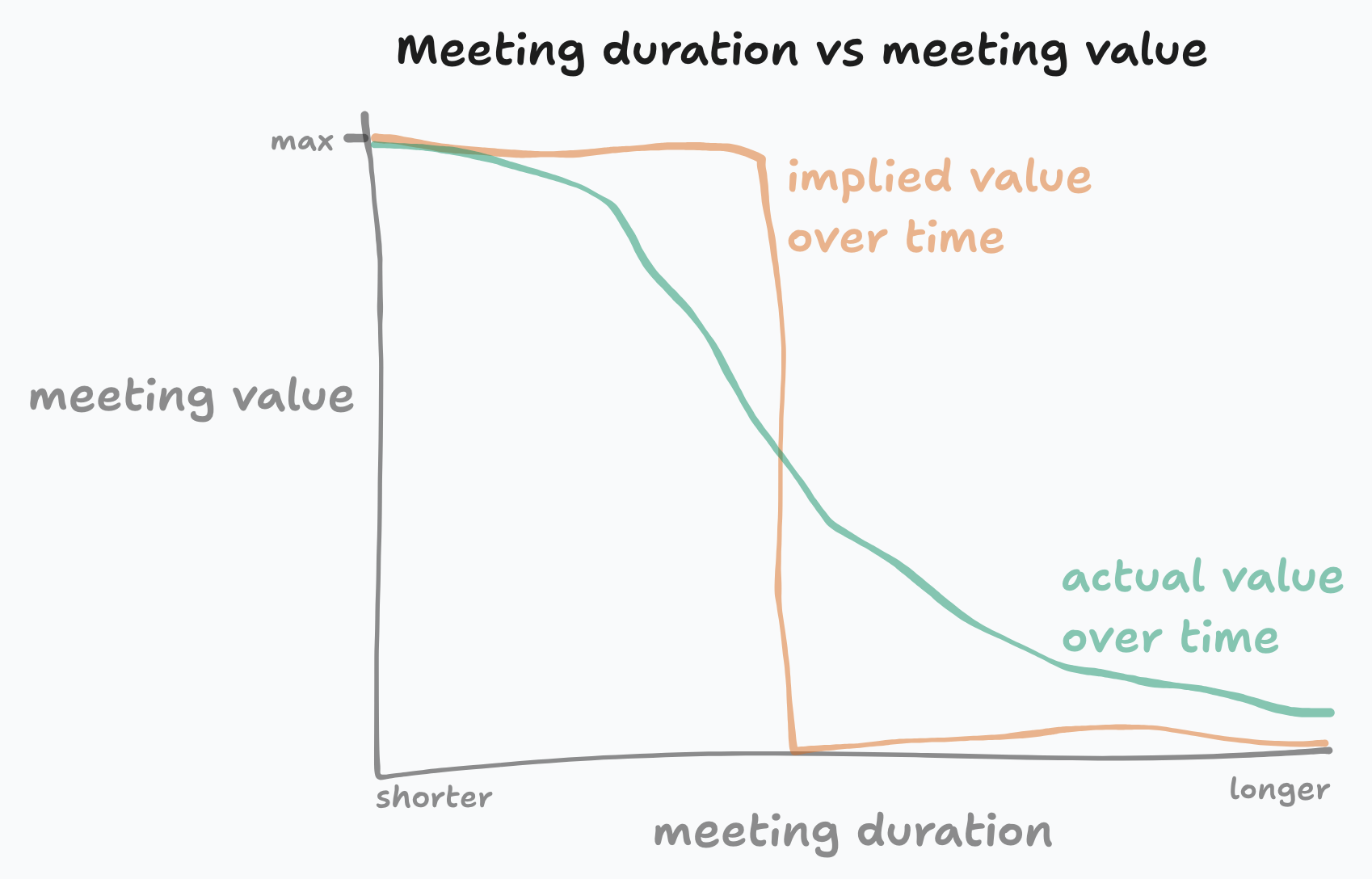
If you’re wanting to meet with someone, presumably you expect that meeting to be valuable to you. But there’s always the question of how long the meeting should be: ideally you’d like the meeting to end when you stop getting value from the meeting, but you can’t know in advance when this point will be.
Often when the meeting starts it is extremely valuable, because you’ve not yet spoken with this particular person about this particular topic. But then as the meeting goes on, you exhaust the initial questions you had and things become progressively less interesting1. After some amount of time (it might be 10 minutes, an hour, longer), the amount of value you are getting from the conversation starts to drop. Specifically, it drops below some threshold such that it’s no longer valuable for you to keep meeting. At this point, you’d rather end the meeting than continue.
Can we do better?
Scheduling the duration of a meeting is intrinsically a prediction problem: you’re trying to forecast how long it’ll take before you run out of interesting things to discuss. But setting a meeting to be exactly 30m (and so committing to being in the meeting for exactly 30 minutes) has the implication that for exactly half an hour you’ll be getting incredible value, but immediately afterwards you’ll be getting zero value from the meeting. This is untrue: the value of a meeting usually starts out high and then slowly decreases as the meeting goes on and more things get discussed2.
I argue that the way we schedule meetings should embrace this, and we should communicate various percentiles for when we think we’ll get some amount of the total value out of the meeting.
For example, I’m fairly well-versed with wandb.ai, a ML-focused logging and metrics tool. A MATS fellow asked for us to talk about it and for me to run through how it works. We were figuring out how long to meet for, and I thought I could describe 80% of the value in 15 minutes, and then probably get to 95% of the value in 45 minutes. This is useful information! I think giving estimates (however rough) of the time-to-80% value and time-to-95% value is very useful, and then being happy if the person you’re meeting with cuts the meeting short somewhere after your time-to-80% (especially since meetings can have diminishing returns to your time).
In terms of implementing this, I’d suggest agreeing beforehand on when you mutually think you’ll have shared 80% and then 95% of useful information, and then scheduling a meeting for the 95% duration. Commit to checking in at the 80% duration and asking if you’d like to keep going. Sending or linking this essay will give some useful context if you get weird looks.
Importantly, part of the problem is the social friction around ending meetings early. Having a pre-agreed time-to-80%-value is a useful Schelling point which makes it easier to end a meeting early.
Footnotes
-
unless you’re talking to those amazing people in your life where the conversation begets more conversation, and there’s never really a decrease to how much value you get from talking to them. But for this essay I’m mostly talking about business/work/research meetings, where you have many other things you’d prefer to be doing with your time. ↩
-
Okay so it is possible that this isn’t the case: you could have a meeting where at first you have nothing to talk about, but then you randomly stumble across a shared interest and proceed to have really interesting conversations for six hours. If you’re lucky, these people turn into friends and/or partners (: ↩